
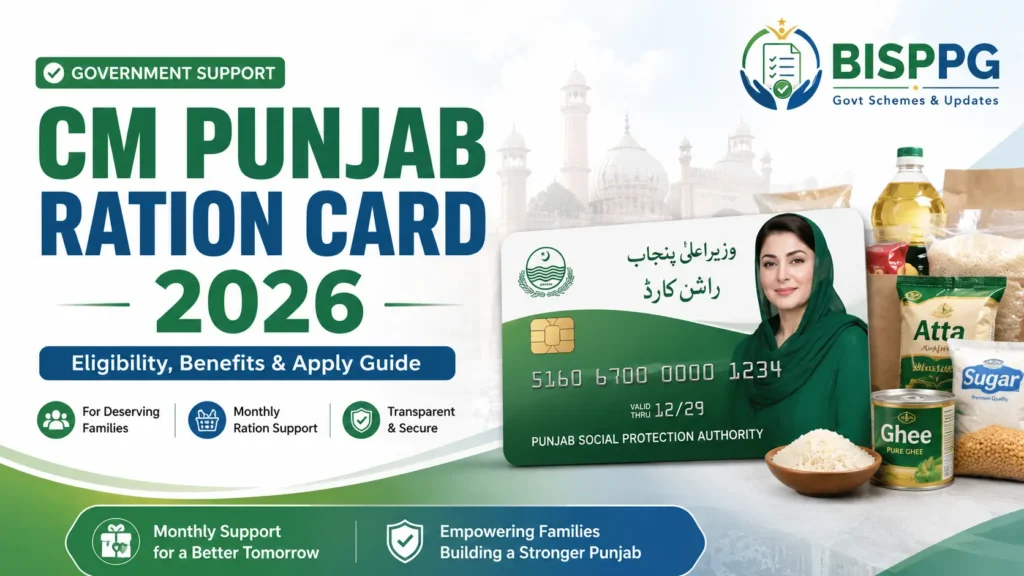
The CM Punjab Ration Card provides Rs. 3,000 per month to eligible low-income households in Punjab, delivered through a digital smart card rather than a physical ration book. Eligibility is determined through PSER registration, CNIC verification, and a Proxy Means Test (PMT) score — not a simple self-reported income figure.
CM Punjab Ration Card — Quick Answer
Register through the PSER portal with your CNIC and household details. If your household’s PMT score and income fall within the programme’s approved thresholds, you’ll receive a digital smart card carrying Rs. 3,000 monthly, redeemable at approved utility stores and registered karyana shops. Applications are also accepted in person at Union Council offices and e-Khidmat Markaz centres.
CM Punjab Ration Card at a Glance
| Feature | Details |
|---|---|
| Programme | CM Punjab Ration Card |
| Province | Punjab |
| Monthly benefit | Rs. 3,000 |
| Purpose | Food and kitchen-expense support |
| Target group | Eligible low-income families and registered workers |
| Verification | CNIC, PSER, and government records |
| Delivery method | Digital smart card |
| Application channels | PSER portal, Union Council, or e-Khidmat Markaz |
| Main items covered | Flour, rice, sugar, ghee, and other essentials |
What Is the CM Punjab Ration Card Program?
It’s a provincial food-support scheme giving eligible low-income households a recurring digital subsidy — typically Rs. 3,000 a month — for kitchen essentials. Eligibility runs through the Punjab Socio-Economic Registry (PSER), which calculates a PMT score from household survey data rather than accepting a self-declared income figure. The benefit is credited digitally and redeemed at registered retailers, which keeps distribution traceable and limits duplicate or fraudulent claims compared to a paper-based system.
Ration Card vs. Maryam Nawaz Ration Card vs. Nigehban — What’s the Difference?
| Feature | CM Punjab Ration Card | Maryam Nawaz Ration Card |
|---|---|---|
| Target | Low-income households | Registered workers |
| System | PSER | PESSI |
| Benefit | Rs. 3,000 monthly support | Rs. 3,000 monthly commodities |
| Verification | PSER/CNIC | Worker registration |
Several Punjab welfare cards share very similar names, and most content online blends them together.
Here’s the actual distinction:
- CM Punjab Ration Card (PSER-based): The general scheme for low-income households identified through PSER registration, launched in 2025 for an initial 1.25 million families.
- Maryam Nawaz Ration Card (PESSI-administered): A related but separate programme run through the Punjab Employees Social Security Institution, specifically for registered workers. It began with mine workers in 2025 and had grown to over 1.4 million registered workers by mid-2026, with more than 1.24 million cards already issued — each carrying Rs. 3,000 in monthly essential commodities, redeemable at roughly 62,000 shops.
- Ramzan Nigehban Card: A seasonal Ramadan-specific top-up combining cash assistance with card-based purchases, approved separately each year alongside relief like Nigehban Dastarkhwan.
If you’re a registered worker under PESSI, you may fall under the second category rather than the general PSER-based card — the eligibility path and administering body are different even though the monthly amount happens to match.
Eligibility Criteria
- Identity: A valid NADRA CNIC, with a mobile number registered against the same CNIC.
- Residence: Permanent Punjab residency.
- PSER registration: Completing PSER registration and passing PSER verification.
- Income: Household income is commonly cited as needing to be below roughly Rs. 50,000/month — but your PMT score, not this figure alone, is the actual determining factor.
- PMT score: A score below roughly 35 is widely cited as the current threshold, though this is set administratively and can be revised, and some priority categories may use a lower cutoff.
- Not currently eligible: government employees, and — under current criteria — families already receiving BISP benefits.
- One per household: only one person from each family may apply.
Because the exact income and PMT thresholds are reported slightly differently across sources and can be revised, confirm your specific case directly through the PSER portal rather than relying on any fixed number, including the ones above.
Required Documents
- Valid CNIC
- CNIC-linked, active mobile number
- Punjab residence details
- Household and family information
- Monthly income information
- PSER registration details
- Any additional socioeconomic information requested during verification
Only submit extra documents if specifically requested through an official Punjab Government or PSER channel — don’t pre-emptively hand over anything to an unofficial site or agent.
How to Apply Online
- Visit the official PSER portal and begin PSER registration with your CNIC and mobile number.
- Log in and complete the application form with your personal, household, and socioeconomic details — matching your official records exactly.
- Review everything carefully before submitting; government and database verification then checks whether your household meets programme requirements.
- Check your status regularly through the portal, and keep your registered mobile number active for SMS confirmations or further instructions.
If you’re already receiving other government assistance, check the programme’s overlap rules — for example, review your BISP Kafaalat eligibility by CNIC before applying, since current criteria exclude BISP beneficiaries from this specific card.
Offline Registration
Offline registration helps applicants without reliable internet access, or those who need help completing or correcting PSER information. PSER field teams conduct door-to-door surveys with district administrations, and in-person help is also available at e-Khidmat Markaz centres or Union Council offices.
How to Check Your Application Status
- Visit the official PSER portal or a government-authorized system.
- Enter your CNIC in the status-checking section.
- Review your application or beneficiary status on screen.
- If unavailable online, visit a physical government service centre for verification.
- Only trust SMS updates from a shortcode confirmed by an official Punjab Government source, and keep any official confirmation message for your records.
Where the Ration Card Can Be Used
Beneficiaries make purchases at authorized stores after CNIC or card verification confirms an eligible subsidy. Depending on your area, the retail network may include registered grocery shops, karyana shops, utility stores, and other government partner outlets — access points vary by location, but the type of approved merchant stays consistent, and purchases outside this network aren’t covered.
Common Mistakes to Avoid
Most delays come from application errors rather than actual eligibility problems:
- Duplicate applications
- Inaccurate household data
- An inactive or unregistered mobile number
To avoid these:
- Confirm your mobile number is registered on your own CNIC before applying.
- Avoid unauthorized agents or unofficial websites asking for a fee.
- Never share your CNIC OTP with anyone claiming to represent a “CM Office” or helpline.
- Trust status updates only from the official PSER portal or an officially announced SMS shortcode.
Widows and families caring for parentless children may also want to review the separate CM Punjab Rehmat Card eligibility criteria.
Latest 2026 Update
As of the most recent confirmed figures, the worker-focused component of the programme (Maryam Nawaz Ration Card via PESSI) has grown to over 1.4 million registered workers, with more than 1.24 million cards already issued and the remainder in processing. The Punjab government approved an additional Rs. 43.2 billion for the programme and confirmed its continuation into the 2026–27 financial year, with essential commodities now available through roughly 62,000 participating shops. Separately, a Ramadan-specific ration card and Nigehban Dastarkhwan arrangement was approved earlier in 2026 as part of that year’s seasonal relief package.
Because budgets, thresholds, and enrollment figures are revised periodically, confirm the latest numbers against the PSER portal or official Government of Punjab statements before relying on them for a personal decision.
Frequently Asked Questions
What Is the CM Punjab Ration Card Program 2026?
The CM Punjab Ration Card is a Punjab Government welfare program that provides Rs. 3,000 monthly assistance to eligible low-income families for essential food and household expenses.
Who Can Apply for the Punjab Ration Card?
Permanent Punjab residents registered with PSER may apply if they meet the official income, PMT score, CNIC, and other eligibility requirements.
What Is the Income Limit for the Punjab Ration Card?
Household income is commonly reported as needing to be below Rs. 50,000/month, though the PMT score generated from your PSER survey — not a simple income figure — is the actual determining factor. Confirm your specific case through PSER.
What PMT Score Is Required?
A PMT score below 35 is widely cited as the current threshold, but this figure is set administratively and can be revised. Check your own score and status directly through the PSER portal rather than relying on a fixed number from a third-party source.
How Can I Apply Online?
Applicants can register through the PSER system using their CNIC, mobile number, household details, income information, and other required socioeconomic data.
What Information Is Required for Registration?
Applicants generally need a valid CNIC, CNIC-linked mobile number, PSER details, household information, and income details for registration and verification.
How Can I Check My Ration Card Status?
Applicants should check updates through official Punjab Government and PSER channels and keep their registered mobile number active for official notifications.
Is Punjab Ration Card Registration Free?
The official program does not list a separate registration fee. Applicants should avoid paying unofficial agents for registration or guaranteed approval.
Can Government Employees Apply?
government employees not eligible BISP beneficiaries not eligible only one family member can apply
Can BISP Beneficiaries Apply?
According to currently reported criteria, families already receiving certain government assistance programs may not qualify. Applicants should confirm their status through PSER.
Can More Than One Family Member Apply?
No. Only one person from each family can apply for the Punjab Ration Card.
Where Can the Ration Card Be Used?
Approved beneficiaries can use the card at participating utility stores and registered karyana shops for eligible grocery purchases.
Is CM Punjab Ration Card the Same as Ehsaas Rashan?
No. The CM Punjab Ration Card and Ehsaas Rashan are separate welfare programs with different eligibility rules and benefit structures.
Is CM Punjab Ration Card registration open in 2026?
Registration availability depends on Punjab Government announcements. Applicants should check PSER and official channels for current updates.
How can I register for CM Punjab Ration Card online?
Registration is completed through PSER using CNIC, mobile number and household information.
Final Guidance
The CM Punjab Ration Card provides meaningful, recurring monthly support to eligible low-income households and registered workers. Complete your PSER survey carefully, use a mobile number registered against your own CNIC, and provide accurate household and income information — most delays come from application errors, not eligibility itself.
Updated: September 2026 Reviewed against: the official PSER portal and ProPakistani’s July 2026 reporting on programme funding and enrollment figures