
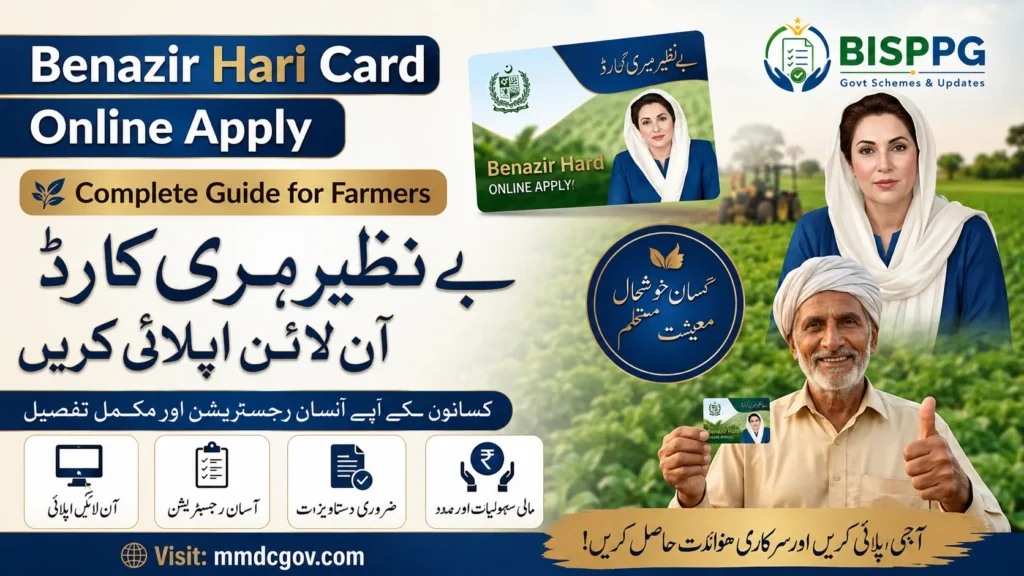
The Benazir Hari Card is a Sindh government scheme that registers small farmers onto a digital, bank-linked card so they can receive subsidies on seeds and fertiliser, access interest-free agricultural loans, and get emergency support after floods or crop losses. It was launched by the Sindh Agriculture Department in October 2024 and is still being rolled out in phases across the province in 2026.
This guide explains who qualifies, what the card actually pays for, how to register, and how to check your application status using your CNIC — along with where official information is still inconsistent, so you know what to double-check before relying on it.
Benazir Hari Card 2026 Overview
| Key Detail | Current Information |
|---|---|
| Programme | Benazir Hari Card (BHC) |
| Administered by | Agriculture Department, Government of Sindh |
| Target beneficiaries | Up to 1.4 million small and marginal farmers in Sindh |
| Typical land holding covered | Small farmers, generally cited as roughly 1 to 25 acres (exact cut-off varies by phase — confirm on the portal) |
| Delivery partner | Sindh Bank (ATM card, bank account, biometric verification) |
| Registration portal | cms.benazirharicard.gos.pk/farmers/registrations |
| Helpline | 03111646111 |
| Cost to apply | Free |
What Is the Benazir Hari Card?
The Benazir Hari Card is a digital identity and payment card for small farmers in Sindh, issued by the province’s Agriculture Department in partnership with Sindh Bank. Registered farmers get a bank account, an ATM card, and biometric verification, which the government uses to deliver subsidies and loans directly instead of through middlemen.
The scheme was formally launched in October 2024, with Pakistan Peoples’ Party chairman Bilawal Bhutto Zardari presiding over the launch event, and Sindh Chief Minister Murad Ali Shah has since announced phased expansion of registration and card issuance. The programme’s stated target is to register 1.4 million farmers across Sindh, rolling out in successive phases rather than all at once — the first phase covered roughly 298,000 farmers.
Who Runs the Programme
The Benazir Hari Card is run by the Agriculture Department, Government of Sindh, not by the federal Benazir Income Support Programme (BISP). This distinction matters because many farmers mistakenly try to check their Hari Card status on the BISP 8171 portal, which will not show Hari Card data. The two programmes are administratively separate, even though both carry the “Benazir” name.
Who Is Eligible for the Benazir Hari Card?
Eligibility is built around genuine, working small farmers in Sindh rather than large landowners. Based on official announcements and departmental briefings, the core criteria are:
1- Residency
You must be a resident farmer of Sindh province.
2- Land holding
The scheme targets small and marginal farmers. Government statements and district-level reporting have cited slightly different thresholds at different times — some describe farmers owning 1 to 25 acres, while a related wheat-support phase specifically covered growers with 1 to 25 acres receiving per-acre fertiliser assistance, and some third-party guides cite a lower cap around 12.5 acres. Because this figure has not been stated identically across all official communications, treat any specific acreage limit as indicative, and confirm your own eligibility directly through the registration portal or your district Agriculture Office.
3- Valid CNIC
A NADRA-issued CNIC is required as proof of identity.
4- Land or cultivation record
Proof of land ownership or tenancy/cultivation (such as Form-7 revenue records) is generally required for verification.
5- Not already covered by a conflicting scheme
Field verification checks for duplicate registrations and data accuracy before approval.
Priority Groups
District Agriculture Offices have also flagged that farmers with incomplete or incorrect Form-7 records, fingerprint verification failures, or CNIC number mismatches should contact their local Additional Director of Agriculture Extension directly to correct their file, since these issues are a common reason registrations stall.
What Benefits Does the Hari Card Provide?
Once registered and verified, the Hari Card gives farmers access to:
- Input subsidies — support toward the cost of seeds, DAP and urea fertiliser, and pesticides. In one 2026 phase, verified wheat growers received subsidised urea (two bags per acre at Rs. 8,000) after DAP usage was confirmed.
- Interest-free agricultural loans to cover cultivation costs.
- Direct cash transfers during natural calamities such as floods or crop failure.
- A linked Sindh Bank account and ATM card, so support is paid directly rather than through local intermediaries.
- Biometric-based verification, intended to reduce fraud and duplicate claims.
Some regional pilots have also paired Hari Card registration with related agricultural subsidies, such as solar-powered drip irrigation support for smallholders. These add-on schemes vary by district and phase, so availability should be confirmed locally rather than assumed.
Documents Required for Registration
Keep these ready before you start:
- Original CNIC (front and back)
- Recent passport-size photograph
- Proof of land ownership or cultivation record (e.g., Form-7)
- Active mobile number for SMS/OTP verification
- Any additional documents requested by the registration portal or your district Agriculture Office
How to Register for the Benazir Hari Card (Step-by-Step)
Check basic eligibility
Confirm you are a Sindh-based small farmer with a valid CNIC and land or cultivation record before starting.
1- Go to the official registration portal
Register through the CMS Benazir Hari Card portal at cms.benazirharicard.gos.pk/farmers/registrations, or use the official Android/iOS app if available in your area.
2- Enter your details
Provide your CNIC number, personal information, land details, and contact number.
3- Upload your documents
Attach your CNIC copy and land/cultivation proof as requested.
4- Submit and wait for field verification
An Agriculture Officer will typically verify your land record and data before approval.
5- Complete biometric verification at Sindh Bank
Once your file is approved, visit your nearest Sindh Bank branch for thumb verification to activate your card.
Receive your card
After activation, the card functions like a standard ATM card for withdrawing subsidies and accessing loan facilities.
If you’re unsure which step you’re on, your district Agriculture Office or the helpline can tell you where your file currently stands.
How to Check Your Benazir Hari Card Status Online by CNIC
- Visit the official portal: benazirharicard.gos.pk
- Find the status/tracking section and enter your 13-digit CNIC number (no dashes).
- Submit to view your registration and verification status.
- If your card has moved to the biometric stage, Sindh Bank may also send an SMS to your registered mobile number once it’s ready for collection.
You can also check progress through the Farmer mobile app or by visiting the CMS portal to see whether any “objections” have been raised against your submitted data.
Common Problems and How to Fix Them
| Problem | Likely Cause | What to Do |
|---|---|---|
| “Record Not Found” | Local field data not yet uploaded | Confirm your documents were submitted correctly at the district office, then recheck after a few days |
| Fingerprint/biometric mismatch | NADRA biometric data mismatch | Visit your district Agriculture Extension office or Sindh Bank branch to resolve |
| Incorrect Form-7 land record | Revenue record error or outdated entry | Contact the Additional Director of Agriculture Extension in your district to correct it |
| CNIC number mismatch | Data entry error during registration | Report to the local Agriculture Office for correction before re-verification |
Benazir Hari Card vs Other Sindh/Federal Welfare Cards
Farmers often confuse the Hari Card with other similarly named schemes. The key difference: the Hari Card is Sindh-specific and agriculture-focused, run by the provincial Agriculture Department, while BISP/8171 is a federal cash-assistance programme for low-income households generally, run separately from provincial farmer schemes. The Sindh Mazdoor Card, meanwhile, targets unorganised urban and industrial labourers rather than farmers. If you’re checking eligibility for household cash support rather than farm subsidies, that falls under the BISP 8171 process, not the Hari Card.
Where the Programme Stands Now 2026 Updates
Registration has continued in phases through 2026, with district-level reporting showing thousands of additional farmers registered under both the Hari Card and a linked Wheat Financial Assistance Program. Farmers with data errors — incorrect Form-7 entries, fingerprint issues, or CNIC mismatches — have been specifically advised to contact their district Additional Director of Agriculture Extension to get these corrected, rather than resubmitting a fresh application. As with any multi-phase government rollout, exact registration numbers and district coverage change frequently; always check the official portal for your district’s current phase rather than relying on a fixed figure.
Official Contact Details and Fraud Warning
- Official website: benazirharicard.gos.pk
- Helpline: 03111646111
- Registration portal: cms.benazirharicard.gos.pk/farmers/registrations
Because this scheme is in high demand, fraudulent pages, WhatsApp groups, and agents claiming to “fast-track” registration for a fee have been reported. The Benazir Hari Card is completely free to apply for. Never pay anyone to register or “guarantee” your approval, and only enter your CNIC or personal data on the official government portal.
Frequently Asked Questions
What is the Benazir Hari Card?
It is a Sindh government scheme that provides small farmers with subsidies, interest-free loans, and crop-loss support through a bank-linked card.
Who is eligible?
Small and marginal farmers in Sindh with a valid CNIC and proof of land ownership or cultivation.
Is the Benazir Hari Card free?
Yes. Registration and card issuance are free.
How can I check my status?
Visit benazirharicard.gos.pk and enter your 13-digit CNIC in the status section.
Why does it show “Record Not Found”?
Your data may not have been uploaded yet. Contact your district Agriculture Office and check again later.
What documents are required?
A valid CNIC, recent photo, and proof of land ownership or cultivation.
Where do I collect the card?
After verification, complete biometric verification at a designated Sindh Bank branch.
Is it the same as BISP 8171?
No. The Hari Card is for farmers in Sindh, while BISP 8171 is a federal cash-assistance programme.
How many farmers will benefit?
The programme aims to cover up to 1.4 million farmers across Sindh.
What benefits are included?
Seed and fertiliser subsidies, agricultural loans, crop-loss support, and a linked Sindh Bank ATM card.
What if fingerprint verification fails?
Visit your Agriculture Extension Office or Sindh Bank branch for assistance.
Who launched the Benazir Hari Card?
It was launched by the Sindh Agriculture Department in October 2024, with Bilawal Bhutto Zardari presiding over the launch.